


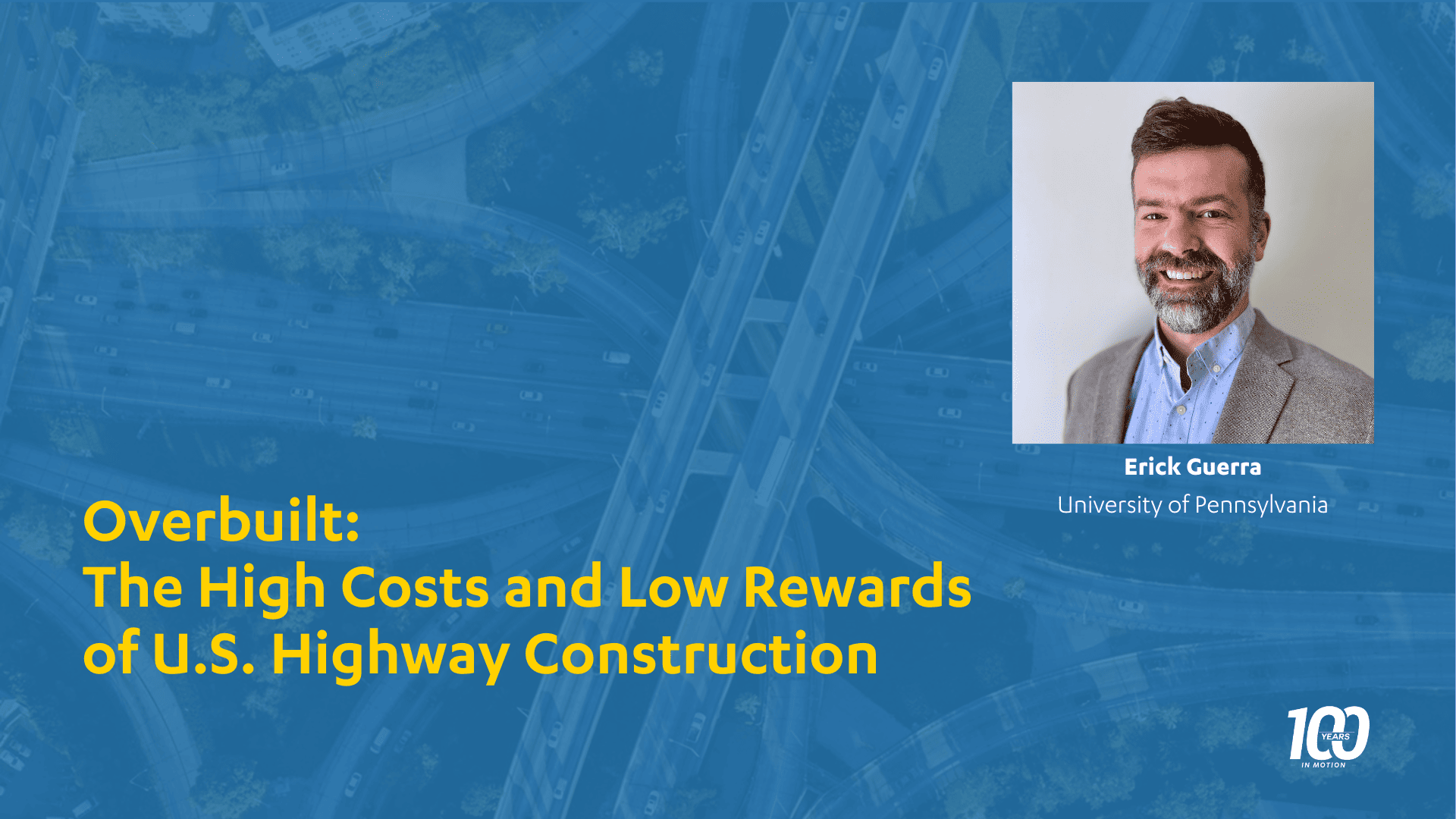
Overbuilt: The High Costs and Low Rewards of U.S. Highway Construction
Since the 1956 inception of the Highway Trust Fund, the U.S. has spent approximately $2.5 trillion (inflation-adjusted) on highways, with 60% of that investment occurring after the Interstate System was largely completed in 1992. Despite shifting public priorities toward safety and equity, planners have since added 75% more urban interstate lane miles.
In this lecture, Erick Guerra reflects on his book Overbuilt and argues that the costs of this continued expansion outweigh the benefits. He traces the historical context of our roadway obsession and examines the economic and social consequences of overbuilding. By analyzing the mechanics of the gas tax and transportation finance, Guerra reveals why the U.S. remains committed to increasing roadway capacity. Importantly, the book provides a roadmap for reform, showing how new evaluation measures can help policymakers stop and correct decades of overbuilding.
 ERICK GUERRA, Ph.D., is Professor of Regional Planning and Associate Dean for Research at the Weitzman School at the University of Pennsylvania, where he teaches courses in transportation planning and quantitative planning methods. His research focuses on relationships between land use, transportation systems, and travel behavior with an emphasis on rapidly motorizing cities, public health outcomes, and transportation technologies. He has published dozens of peer-reviewed journal articles on topics, including land use and transportation in Mexico and Indonesia, highway policy, public transport policy, automated traffic enforcement, land use and traffic safety, and contemporary planning for self-driving vehicles.